Speech-to-Text Latency
The Speech-to-Text Latency report shows response times for application requests made to the speech recognition API over the selected period of time.
Aggregate data includes the min, max, and average latency for both the final and the first intermediate response times. These are defined as follows:
- First intermediate result - Time from start of speech detection to the time the API sends the first intermediate result back to the application.
- Final result - Time from end of speech detection to the time the API sends the final result back to the application.
In addition to the use of report filters, Nuance Insights allows you to manipulate displayed data through several other means in order to better visualize information. Select from the following to learn more:
Note: This report is applicable only for clients using the Conversational AI channel.
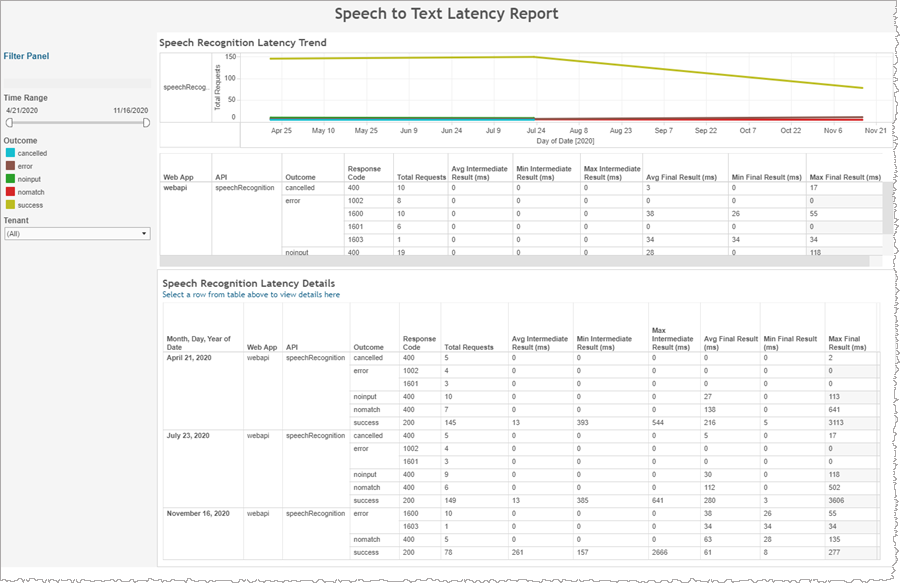
Note: The report only applies to successful requests. Latency is expressed in seconds, for example 1.23.
| Column | Description |
|---|---|
| Web App | Web application |
| API |
API command (for example, |
| Response Code | Code returned in the command response. For a successful request the code is 200. Codes above 1000 are API error codes. |
| Total Requests | Total number of requests for this combination of dimensions |
| Avg Intermediate Result | Average latency for the first intermediate result |
| Min Intermediate Result | Minimum latency for the first intermediate result |
| Max Intermediate Result | Maximum latency for the first intermediate result |
| Avg Final Result | Average latency for the final result |
| Min Final Result | Minimum latency for the final result |
| Max Final Result | Maximum latency for the final result |
Visualizations
Speech Recognition Latency Trend graph
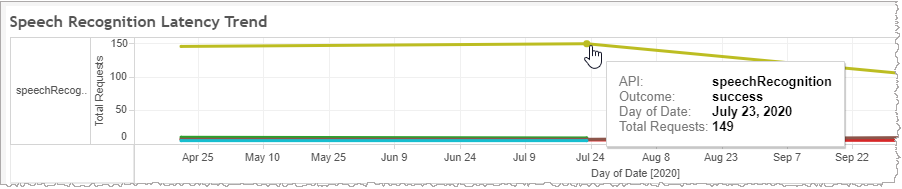
This trend line graph plots the change in the number of recognition requests on a per outcome basis over time. Each outcome is color-coded. Mouse over data points to see relevant latency data in a tooltip.
Tables
The Summary table summarizes speech recognition latency, grouping by outcome. The Details table (the second table) presents the same data, also grouped by outcome, but broken out by date.
Filters
Time Range
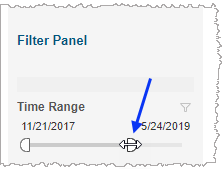
The Time Range slider allows you to narrow or expand the date range. The data displayed in all visualizations automatically reflect the subset of information falling within the selected range.
Tenant
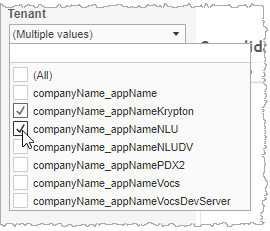
By choosing one or more tenants from the list, you refine your displayed data-set by including data from only those tenants matching the selection. The visualizations automatically reflect the information complying with the tenant selection.