Mix Integer Metrics
The Mix Integer Metrics report visualizes all metrics having an integer data type.
Visualization
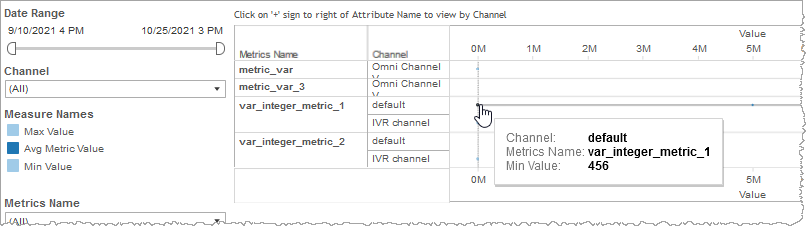
The graph visualizes the range of integer metric values in the data across all channels and on a metric-by-metric basis. On each range graph, color-coded dots mark the minimum, average, and maximum values in the visualized data. Optionally, you can further split out the data on a per channel basis by exposing the Channel column.
The min, max, and average metric values adjust accordingly depending on whether you split out data by channel or not. To see the Channel column, click the plus (  ) sign at the top of the Metrics Name column. If the Channel column is visible, the displayed min, max, and average metric values are on a per channel basis. If the Channel column is not visible these values are taken across all channels.
In the example, below, for the default channel, the minimum recorded value for the var_integer_metric_1 metric, given the constraints of the filter settings, was 456.
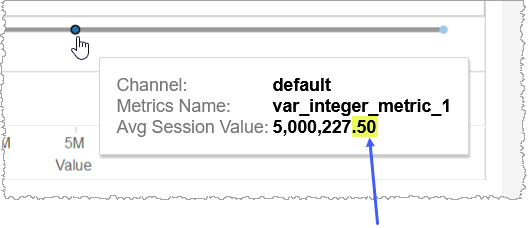
Although this report visualizes integer metrics exclusively, the Avg Session Value is a calculated metric and will be a floating point value. The graphic, below, displays a floating point value for the calculated average session value which is based on integer metric values.
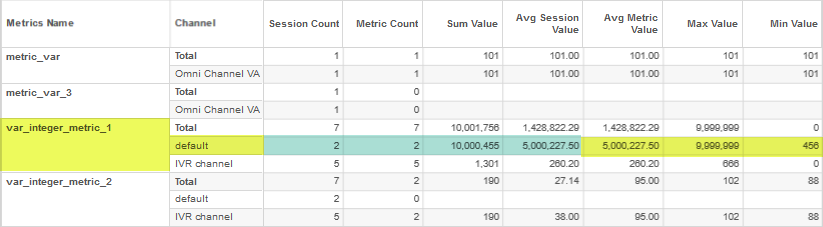
The table presents more data in tabular form. The aggregate of all information from tool tips for the Min Value, Max Value, and Avg Session Value for the range graph depicted above are highlighted as yellow in the table, below. The table further adds raw session and metric counts, sum value and average session value (highlighted blue).
Note: In the table, to see the Channel column, click the plus ( ) sign at the top of the Metrics Name column.
Filters
Increase the specificity of your view's reporting by applying filters to the data.
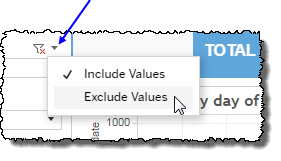
 includes data containing specified filter values or else excludes this subset of data.
Clicking Include values displays only those data possessing the selected values. All other data are hidden from the visualization.
By contrast, clicking Exclude values displays only those data that do not possess the selected values.
Date Range
The Date Range filter is a slider with two moveable sides. By narrowing the date range, you display only data falling within the range.
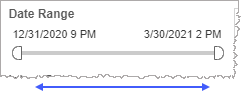
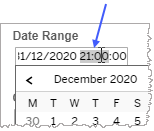
In addition to the slider, the filter allows you to specify start and end points to the range by time of day as well as by date by clicking the Start and End regions, clicking a second time on the time of day, and then manually entering a new time of day.
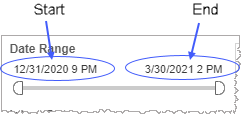
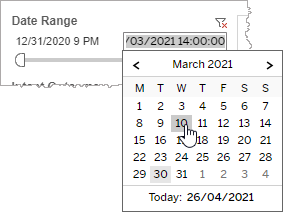
To select a date with the date picker, click the Start region to pick a date from the date picker widget. Do the same with the End region.
Channel (filter)
By choosing one or more channels from the list, you refine your displayed data-set by including data from only those channels matching the selection.
- Select all available values by selecting All.
- Select only one value by first clearing the All checkbox, and then selecting the value whose data you would like to see visualized.
-
Select several values by doing one of the following:
- Clear the All checkbox, and then select the values whose data you would like to see visualized.
- Select the All checkbox and then clear values whose data you would NOT like to see visualized.
Metrics Name
By choosing one or more decimal metrics (floating point data type) from the list, you refine your data-set by including only those metrics matching the names selected.
- Select all available metrics by selecting All.
- Select only one metrics by first clearing the All checkbox, and then selecting the name of the metric whose data you would like to see visualized.
-
Select several metrics (but a subset of all metrics) either by performing one of the following two actions:
- Clear the All checkbox, and then select the names of the metrics whose data you would like to see visualized.
- Select the All checkbox (or ensure it is already selected), and then clear the names of the metrics whose data you would NOT like to see visualized.
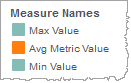
Measure Names
Use this filter to highlight data having one or several specified measure names.
- In the highlight tool, mouse over the word Measure Names to see the highlighter icon to the right.
-
Click the highlighter icon to toggle on (
 ) to highlight measure names, or off (
  ) to remove highlighting.Notes:
- To make multiple selections, hold down the ctrl key while individually clicking desired measure names.
- If you made a highlighter selection of measure names and then toggled the highlighter function off, the last selection is preserved when you once again toggle the highlighter back on.
Custom filters
This report accommodates customizable filters.
Customizable filters narrow the scope of the reported dataset by including or excluding data with identifiable attributes. These attributes may be about the conversation itself or about an event that may have happened during the conversation.
For more information about how to add customized filters to your view, contact your Nuance Professional Services representative.
Note: If you would like to modify this or any report, Nuance Communications, Inc. recommends you contact Nuance Professional Services.
