Task Detail
The Task Detail report shows outcome statistics for a selected task on a per channel basis in more detail than the Task Summary report by focusing on more detailed outcome categories.
Task data is visualized in two sections: Broad Category Breakdown and Detailed Category Breakdown. The Broad Category Breakdown section groups task outcomes into fewer and less granular categories to give a general view. The Detailed Category Breakdown section allows you to drill down on any one broad category to find out more details.
Note: The visualizations in the Task Detail report do not populate with data until you select a task in the Task Name filter.
In addition to the use of report filters, Nuance Insights allows you to manipulate displayed data through several other means in order to better visualize information. Select from the following to learn more:
Visualizations
Broad Category Breakdown
You can view the data for this section either as a graphical visualization or in a text-only table. Both formats visualize the relative contribution of individual broad outcome categories relative to all the task outcomes for each channel for the selected task. In the graph, each bar's length represents a broad category's weighting within a given channel. The sum of all outcome percent values (Percent of Outcome) along a given row will always be 100%, signifying the aggregate of all broad task outcomes for all of a channel's executions of the selected task. The table lists broad category weightings for a given channel as percent values.
Note: To see the data from the graphical visualization displayed in an alternative, textual way, click Show Table. To toggle back to the graphical view, click Show Graph.
In the example below, there were 695 executions of the Frequently Asked Questions task in the IVR/Voice VA channel, taken from data falling within the date range and complying with all filter constraints.
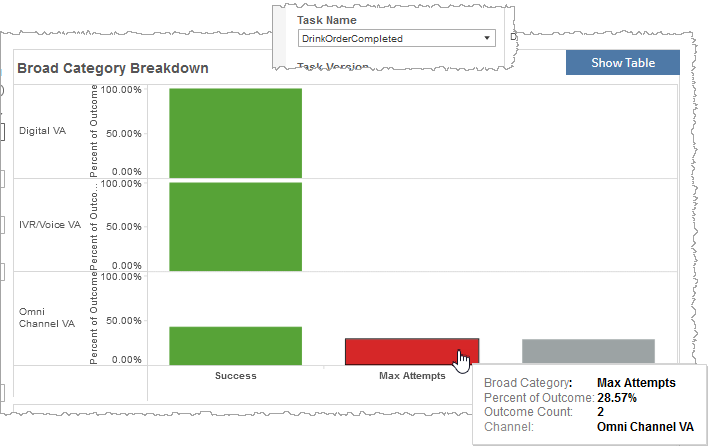
In the graphic, below, the Max Attempts broad category is color-coded red, as described in the Broad Category highlight tool, and represents 2 broad outcome counts (or 28.57% of all broad task outcomes) in the Omni Channel VA channel data for the DrinkOrderCompleted task (as defined in the Task Name filter).
Detail Category Breakdown
You can view the data for this section either as a graphical visualization or in a text-only table. Both formats visualize the relative contribution of individual detailed outcome categories relative to all the task outcomes for each channel for the selected task. In the graph, each bar's length represents a detailed category's weighting within a given channel. The sum of all outcome percent values (Percent of Outcome) along a given row will always be 100%, signifying the aggregate of all detailed task outcomes for each broad category of outcomes within a channel's executions of the selected task. The table lists detailed category weightings for a given channel as percent values.
-
To see the data from the graphical visualization displayed in an alternative, textual way, click Show Table. To toggle back to the graphical view, click Show Graph.
-
The visualizations in the Task Detail report do not populate with data until you select a task in the Task Name filter.
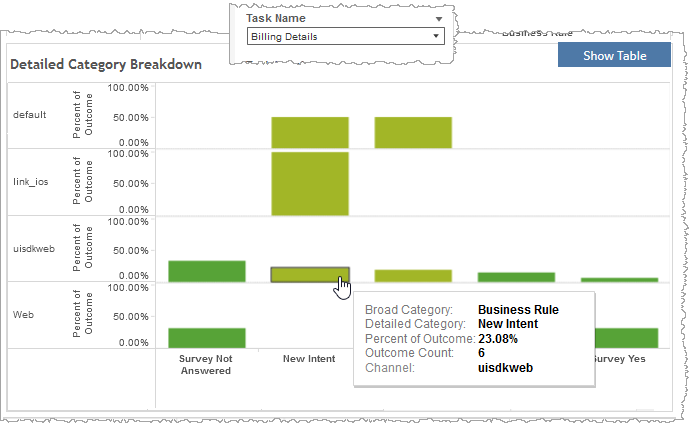
In the graphic, below, the New Intent detailed category is color-coded light green, signifying belonging to the Business Rule broad category in the legend, and represents 6 outcome counts (or 23.08% of all detailed task outcomes) in the uisdkweb channel data for the Billing Details task (as defined in the Task Name filter).
Tabular view
Both graphs' data is visible in a single table along with additional raw and calculated metrics such as average duration, grand total of percent outcome (should always be 100%), and significant end state name.
Note: The Percent of Outcome column of the table represents the percent contribution of detailed categories relative to the sum of all detailed outcome counts across all detailed categories for the selected task in a given channel.
Filters
Increase the specificity of your view's reporting by applying filters to the data.
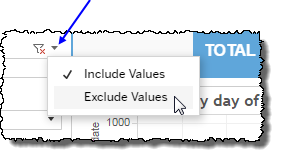
 includes data containing specified filter values or else excludes this subset of data.
Clicking Include values displays only those data possessing the selected values. All other data are hidden from the visualization.
By contrast, clicking Exclude values displays only those data that do not possess the selected values.
Date Range
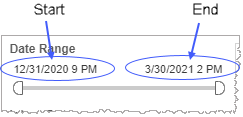
The Date Range filter is a slider with two moveable sides. By narrowing the date range, you display only data falling within the range.
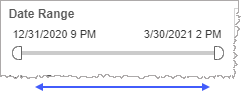
In addition to the slider, the filter allows you to specify start and end points to the range by time of day as well as by date by clicking the Start and End regions, clicking a second time on the time of day, and then manually entering a new time of day.
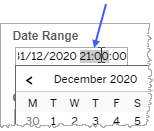
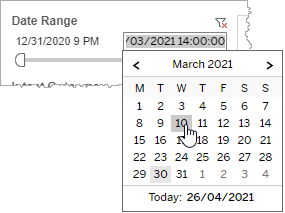
To select a date with the date picker, click the Start region to pick a date from the date picker widget. Do the same with the End region.
Task Name
The Task Name filter allows you to narrow the displayed data in your view by including only those tasks bearing the selected task name.
Task Version
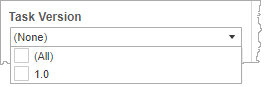
The Task Version filter allows you to narrow the displayed data in your view by including only data associated with all, several, or only one task version, as configured.
A task version is the number identifying the revision of a task definition. Task definitions may change over time for a number of reasons. One example is if you find there are several navigational exits that are categorized as Other. In this case, you may want to recategorize them with more meaningful labels which, in turn, may warrant an update to your task definitions. Another example is if the application itself is updated such that there are now more states or more ways in which scenarios are handled. Again, in this case, you may want to revisit your task definitions with a new revision to correctly capture successes and failures.
The Task Version filter is an auto-populated filter based on data made available in the AFT file.
- Click the Task Version field.
-
Select the All checkbox to include data associated with all task versions.
If there are many task versions available and you would like to select one or just a few of them, clear the All checkbox and then select each task version you would like to include in your query.
Task Attempt
The Task Attempt filter allows you to narrow the displayed data in your view by discriminately including task data associated with all, some, or a single task attempt.
A task attempt is identified by an index number (for example, Attempt 1 or Attempt 2) and corresponds to a task being started. Notably, a task attempt does not necessarily end with a task completion. It is only necessary for the task to begin for it to be an attempt.
When filtering for task attempts, you may select one, several, or all task attempts:
- Selecting only one task attempt (attempt 3, for example) is a request to exclude all task data except data associated with a third attempt.
-
Broadening the filter to include several task attempts requests the reporting of data associated with the selected attempts, but excluding all other data.
For example, selecting attempts 3, 7, and 9 in the Task Attempt filter requests that only task data associated with the third, seventh, and ninth attempts of the given task(s) will be reported.
- Selecting all task attempts requests the reporting of task data associated with any and all task attempts. This filter parameter is the same thing as having no Task Attempt filter at all.
The Task Attempt filter is an auto-populated filter based on data made available in the AFT file.
Channel
By choosing one or more channels from the list, you refine your displayed data-set by including data from only those channels matching the selection.
- Select all available values by selecting All.
- Select only one value by first clearing the All checkbox, and then selecting the value whose data you would like to see visualized.
-
Select several values by doing one of the following:
- Clear the All checkbox, and then select the values whose data you would like to see visualized.
- Select the All checkbox and then clear values whose data you would NOT like to see visualized.
Broad Category highlight tool
defined as follows:
-
Max Attempts - The percentage of instances of a given task, that ended because the incidence of one or more error types has reached a programmatically set limit on the number of times the error may occur.
- System Error - Any application/system-based errors in the application.
- DB Error - An error encountered during a database lookup.
- Other - The percentage of tasks not falling into other categories of outcomes.
-
Transfer Request - The percentage of instances of a given task, in which a user requests an agent regardless of whether a transfer subsequently is completed by the application.
Note: An Agent Request Transfer (not depicted but available through customization) filters the dataset further by including only those tasks with an agent request that actually ended with a successful transfer to an agent. Through customization, you may or may not be able to use this as a category, depending on whether the data indicating whether a transfer occurred is present in the dataset.
-
Business Rule - The percentage of instances of a given task, in which a business rule was triggered. A business rule is defined, programmatically, to anticipate situations in which a task's completion is prevented, and then to effect a graceful course of actions by the application (possibly but not necessarily ending with a transfer to an agent).
Note: A Business Rule Transfer (not depicted but available through customization) filters the dataset further by including only those tasks that ended due to a business rule and that actually ended with a successful transfer to an agent. Through customization, you may or may not be able to use this as a category, depending on whether the data indicating whether a transfer occurred is present in the dataset.
- User Exit - A termination of the conversation initiated by the user.
- Application Exit - A termination of the conversation initiated by the application.
- Diversion - The user chooses to remain in the application but to not complete the task.
- Success - The rate of successful completion of a task, as a percentage of task starts that ended with a successful completion.
Use this tool to highlight data belonging to one or several specified broad categories of task outcomes.
- In the Broad Category highlight tool, mouse over the word Broad Category to see the highlighter icon to the right.
-
Click the highlighter icon to toggle the highlighter on (
 ) to highlight outcomes, or off (
  ) to remove highlighting.Notes:
- To make multiple selections, hold down the ctrl key while individually clicking desired category.
- If you made a highlighter selection of categories and then toggled the highlighter function off, the last selection is preserved when you once again toggle the highlighter back on.
Custom filters
This report accommodates customizable filters.
Customizable filters narrow the scope of the reported dataset by including or excluding data with identifiable attributes. These attributes may be about the conversation itself or about an event that may have happened during the conversation.
For more information about how to add customized filters to your view, contact your Nuance Professional Services representative.
Note: If you would like to modify this or any report, Nuance Communications, Inc. recommends you contact Nuance Professional Services.
