Understanding SIP audio routing
This section shows how audio routing is handled in Voice Platform for deployments using SIP. Audio routing refers to setting up connections between the external world (caller and called parties, the gateway) and Voice Platform. Once connections are established among these components, audio is passed directly between Voice Platform and the gateway using Real-time Transport Protocol (RTP).
This illustration shows the main components involved in a call. Within Voice Platform, the Telephony Session service, Voice Browser service, and Nuance Speech Server have different responsibilities in audio routing.
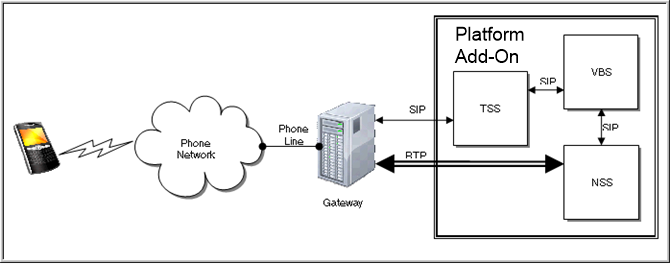
- The audio from a caller is carried over the phone network to a SIP gateway.
- The gateway sends the incoming call as a SIP call to the Telephony Session service.
- The Telephony Session service notifies the Voice Browser service to set up an RTP connection between the Nuance Speech Server and the gateway.
- The audio from the caller is sent on the RTP connection as RTP packets to the Speech Server for recognition.
- Audio prompts from the Speech Server are sent back to the caller as RTP packets on the same RTP connection.
