Agent Transfers
The Agent Transfers report presents two pieces of information about agent transfers in a single graph: raw counts for time periods ranging from a day to a full year, and a trend line showing the ratio of the number of transferred calls to the total number of calls.
Note: This report is applicable only for clients using the IVR channel.
 examples of how to interpret this data:
- A spike in raw count of transfers, with no change in ratio from the previous data point (day, week, month, quarter, or year, depending on the configured Date Granularity), indicates that overall call volume has increased, and that the application is transferring callers at the same rate as in the previous data point.
- A decrease in raw count of transfers, with no change in ratio from the previous data point, indicates that overall call volume has decreased, and that the application is transferring callers at the same rate as in the previous data point.
- A spike in raw count of transfers and a spike in ratio from the previous data point indicates that overall call volume has increased, and that the application is transferring callers at an increased rate from the previous data point.
- A decrease in raw count of transfers and a spike in ratio from the previous data point indicates that overall call volume has decreased, and that the application is transferring callers at an increased rate from the previous data point.
You may adjust the range of the displayed time span with the Date Period selector. Additionally, you may filter with specificity on the basis of any of the dimensions as defined by the AFO file.
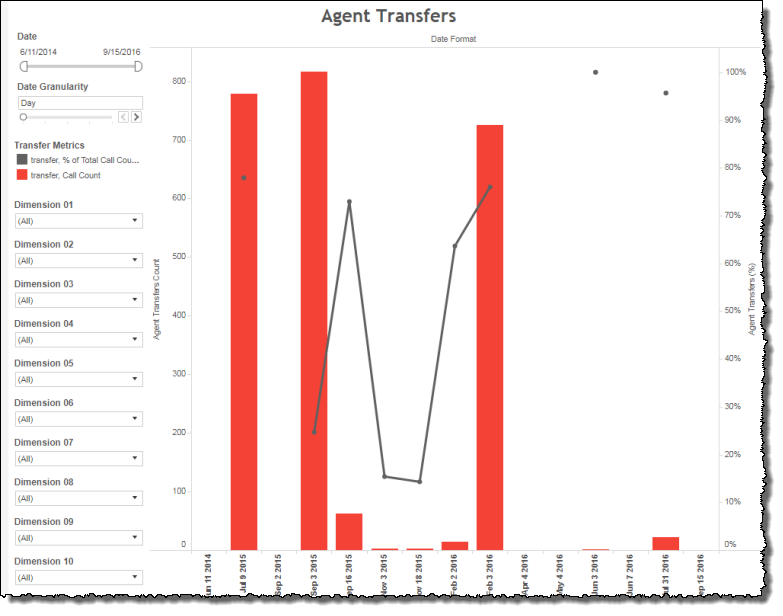
The Agent Transfers report's filters include Date Period. Additionally, there may be up to ten customizable filters, all reflecting data drawn from the AFO file. As with the Date Period filter, the customizable filters allow you to selectively restrict the volume of data being visualized in the graph. In the case of the customizable filters, this is done on a per dimension basis.
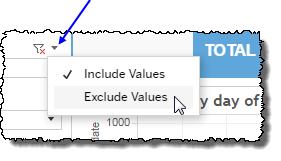
includes data containing specified filter values or else excludes this subset of data.
Clicking Include values displays only those data possessing the selected values. All other data are hidden from the visualization.
By contrast, clicking Exclude values displays only those data that do not possess the selected values.
Date
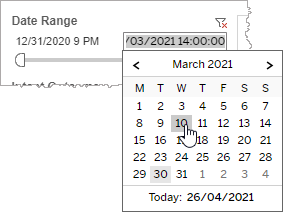
The Date Range filter is a slider with two moveable sides. By narrowing the date range, you display only data falling within the range.
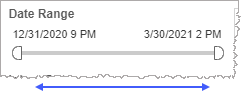
In addition to the slider, the filter allows you to specify start and end points to the range by time of day as well as by date by clicking the Start and End regions, clicking a second time on the time of day, and then manually entering a new time of day.
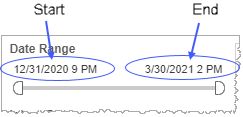
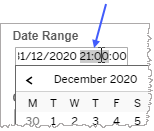
To select a date with the date picker, click the Start region to pick a date from the date picker widget. Do the same with the End region.
Date Granularity
The Date Granularity filter allows you to adjust the reported data granularity described by the trend lines. Drag the slider horizontally to adjust the granularity of reported data. Alternatively, you can use the left  and right
  arrow buttons to move the slider incrementally.

Custom filters
This report accommodates customizable filters.
Customizable filters narrow the scope of the reported dataset by including or excluding data with identifiable attributes. These attributes may be about the caller, the call itself, or about an event that may have happened during the call.
For example, one possible customizable filter you can add and customize in this view is Caller Type, in which you can narrow the reported data to include, or exclude, only those data with the selected caller type.
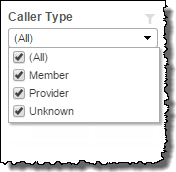
For more information about how to add customized filters to your view, contact your Nuance Professional Services representative.
Note: If you would like to modify this or any report, Nuance Communications, Inc. recommends you contact Nuance Professional Services.
