Articulation of consonants
Consonants can be described by:
- Place of articulation
- Manner of articulation
In the Nuance Recognizer documentation, consonants are described according to the manner of articulation. This characterization makes it easier to group them. It is easy to show where sounds are produced but it is difficult to show how they are articulated.
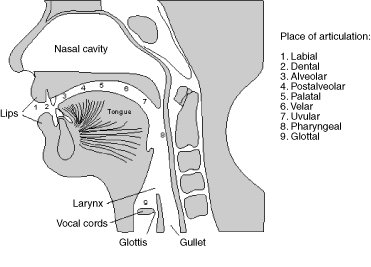
Place of articulation
For a demonstration of what place of articulation means, consider the picture below. It shows the human throat, nose, and mouth region and indicates which places take part in the articulation process.
Plosives
Plosives are articulated with a complete obstruction of the mouth passage that entirely blocks the airflow momentarily. Plosives can be arranged in pairs: voiced plosives vs. voiceless plosives. For example:
/b/ in bed
/p/ in pet
Voiced sounds are produced with the vocal folds vibrating; that is to say, opening and closing rapidly, producing voice. Voiceless sounds are made with the vocal folds apart, allowing the air to pass freely between them.
Fricatives
Fricatives are articulated by narrowing the mouth passage so as to make the airflow turbulent, while allowing it to pass through continuously. As with plosives they can be arranged in pairs of voiced fricatives vs. voiceless fricatives. For example:
/v/ in vine
/f/ in fine
Affricates
Affricates are combinations of plosives and fricatives at the same place of articulation. The plosive is produced first and then released into a fricative.
/tS/ in much
Nasals
Nasals are articulated by completely obstructing the mouth passage and at the same time allowing the air to pass out through the nose.
/n/ in never
Laterals
A lateral is articulated by allowing air to escape freely over one or both sides of the tongue.
/l/ in lobster
Trills
Trills are pronounced with a very fast movement of the tongue tip or the uvula.
/r/ in rave
Laterals and trills are grouped together and may also be referred to as liquids.
Glides
A glide is articulated by allowing air to escape over the center of the tongue through a stricture (in the case of /w/, two strictures) that is not so narrow as to cause audible friction. Glides are also referred to as approximants or semivowels.
/w/ in water
/j/ in young
Speech sounds tend to be influenced by the speech sounds that surround them.
Palatals
Palatals are sounds that are produced by the front upper surface of the tongue touching, or nearly touching, the hard palate at the top of the mouth.
For example, in German the /C/ in ich /IC/ or in Greek /c/ in καιρός /ceros/ is a palatal fricative. There are also palatal nasals like in Greek the /J/ in νιώθω /JoTo/.
