Decision Summary
This report depicts the raw count of decision state outcomes. With the use of filters you can specify a subset of decision states for which you would like to see results. You can further narrow your data-set by adjusting the Date filter accordingly.
Nodes are the units of a speech application that perform a simple operation. Conversation flow charts map how nodes are connected to one another. Decision nodes are nodes tasked specifically with determining what the next node in the conversation flow will be. A Decision state is another name for Decision node.
In addition to the use of report filters, Nuance Insights allows you to manipulate displayed data through several other means in order to better visualize information. Select from the following to learn more:
Decision State Outcomes
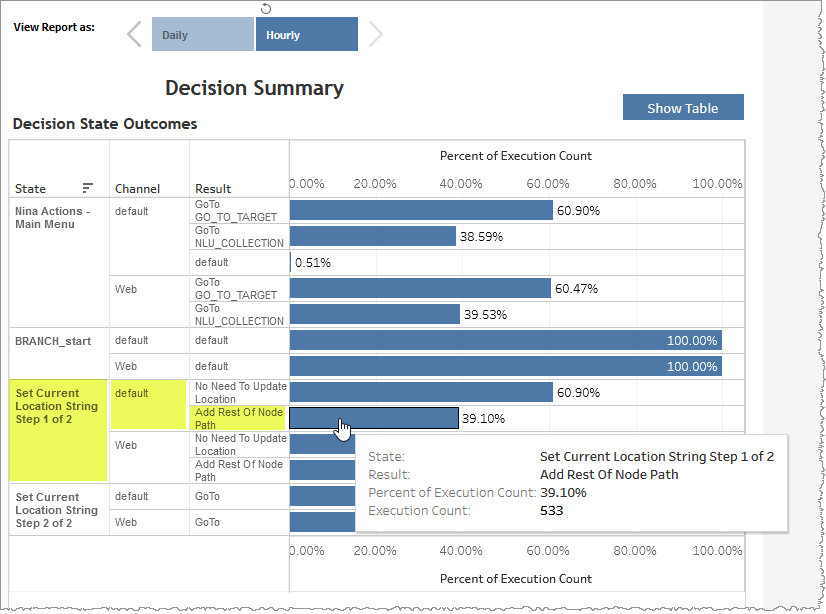
The bar graph visually compares the raw count of results to one another for each applicable decision state. Mousing over any one bar in the graph produces a tool tip with the selected decision state name, selected result, proportion that this result represents compared to all results in this decision (in percent), as well as the overall number of conversations.
You can view data either as a graphical visualization or in a text-only table. Both formats identify decision state, channel (when you drill down), and result on the left. The bar chart on the right visualizes the calculated metric of the percent weighting of execution counts for each result in comparison to the total for the channel or the state (depending on the drill-down level). If you choose to use the graphical visualization, the Percent of Execution Count metric is communicated both through the length of the bar and in numerical form.
In both Graph and Table versions of this section, the metric data (Percent of Execution Count) describes a result based on the most granular dimension in the visualization. By default, State is the most granular dimension (not including Result), which makes the metric quantity a descriptor for a given result for each state.
To drill down so that the metric describes results on a per channel basis, click the  icon in the State column header in either the Graph or Table view.
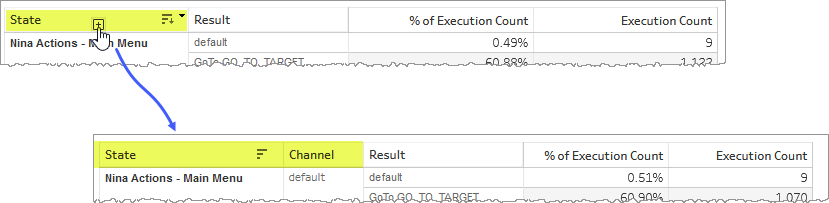
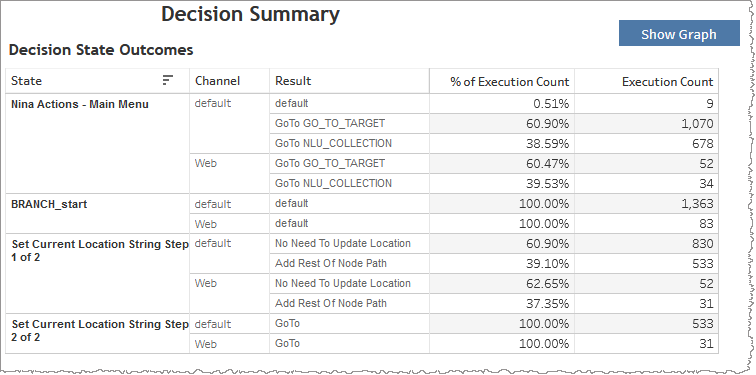
Note: To see the data from the graphical visualization displayed in an alternative, textual way, click Show Table. To toggle back to the graphical view, click Show Graph.
In the example below, there were 533 executions having a result of Add Rest Of Node Path in the default channel and having a decision state of Set Current Location String Step 1 of 2. This count represents 39.10% of all executions regardless of result within this channel and having this decision state.
The table presents the same data in text-only form.
Filters
Increase the specificity of your dashboard's reporting by applying filters to the data. The Decision Summary's filters include Date and Decision. Additionally, the report may include one or more other customized filters depending on what has been configured specifically for your system.
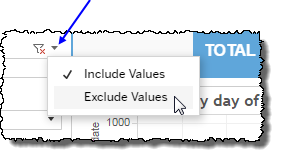
 includes data containing specified filter values or else excludes this subset of data.
Clicking Include values displays only those data possessing the selected values. All other data are hidden from the visualization.
By contrast, clicking Exclude values displays only those data that do not possess the selected values.
Date
The Date Range filter is a slider with two moveable sides. By narrowing the date range, you display only data falling within the range.
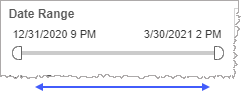
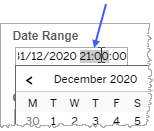
In addition to the slider, the filter allows you to specify start and end points to the range by time of day as well as by date by clicking the Start and End regions, clicking a second time on the time of day, and then manually entering a new time of day.
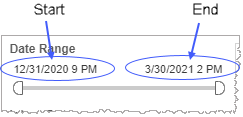
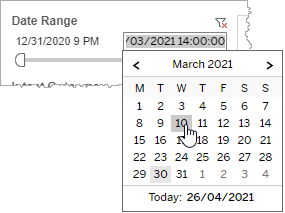
To select a date with the date picker, click the Start region to pick a date from the date picker widget. Do the same with the End region.
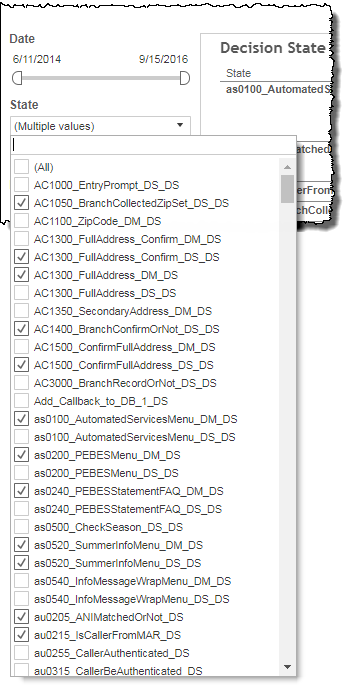
State
By choosing one or more decision states from the list, you refine your data-set by including only those decisions matching the names selected.
- Select all available decision states by selecting All.
- Select only one decision state by first clearing the All checkbox, and then selecting the name of the decision whose data you would like to see visualized.
-
Select several decision states (but a subset of all decisions) by performing one of the following two actions:
- Clear the All checkbox, and then select the names of the decisions whose data you would like to see visualized.
- Select the All checkbox (or ensure it is already selected), and then clear the names of the decisions whose data you would NOT like to see visualized.
Channel
By choosing one or more channels from the list, you refine your displayed data-set by including data from only those channels matching the selection.
- Select all available values by selecting All.
- Select only one value by first clearing the All checkbox, and then selecting the value whose data you would like to see visualized.
-
Select several values by doing one of the following:
- Clear the All checkbox, and then select the values whose data you would like to see visualized.
- Select the All checkbox and then clear values whose data you would NOT like to see visualized.
Custom filters
This report accommodates customizable filters.
Customizable filters narrow the scope of the reported dataset by including or excluding data with identifiable attributes. These attributes may be about the conversation itself or about an event that may have happened during the conversation.
For more information about how to add customized filters to your view, contact your Nuance Professional Services representative.
Note: If you would like to modify this or any report, Nuance Communications, Inc. recommends you contact Nuance Professional Services.
